 English
 Italia
 Tiếng Việt
 Spanish

VIETNAM CLIMATE
Vietnam, a Southeast Asian country located at the easternmost tip of the Indochinese Peninsula, is shaped like a stretched "S". It is a long, rugged strip of land, marked by mountains, coastal plains, and deltas, with its extremities approximately 1,650 km apart and an altitude ranging from sea level to 3,143 m. It is bordered to the west by Laos and Cambodia and to the north by China. Its coastline includes the East Sea (South China Sea), the Gulf of Tonkin, and the Gulf of Thailand. Its maritime border is 3,260 km long.
Due to differences in latitude and varied terrain, Vietnam's climate differs considerably from region to region:
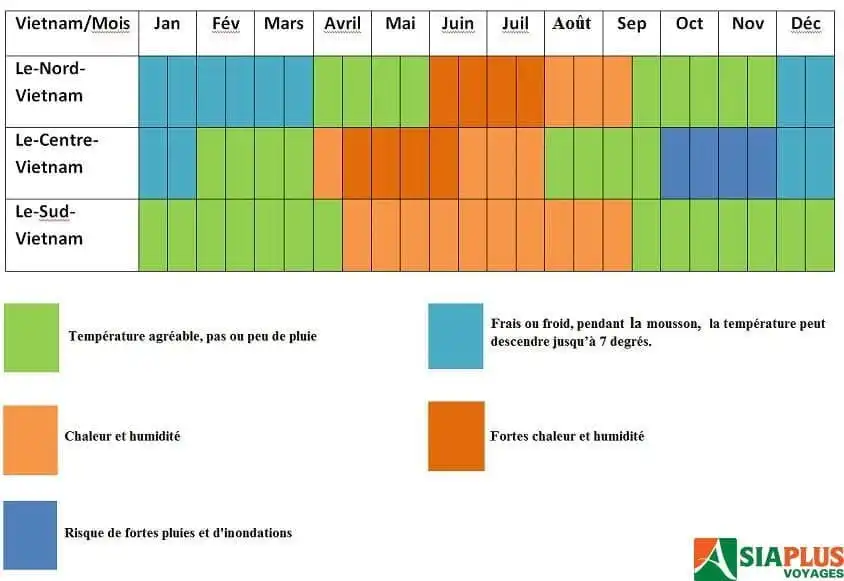
In the North: The northern region of Vietnam is characterized by a tropical monsoon climate, with four distinct seasons: a cool winter with drizzle from January to March and the mountains of the far north experience harsh winters; a hot and humid spring from April to June; a hot, humid and stormy summer from June to August; a pleasant and beautiful autumn from September to December.
In the Central region: The Central region of Vietnam experiences two seasons per year: the dry season extends from February to August with intense heat from mid-April to June; the wet season is also that of typhoons from September to January with risks of heavy rain, especially in October and November.
In the South: A subtropical monsoon climate prevails, with a clear distinction between the dry season (October to March) and the rainy season (April to September). Temperatures remain high year-round in the South, averaging 26°C to 27°C.
Vietnam is a pleasant place to travel all year round. There's no good or bad season to visit the entire country. Its climate can vary greatly at any given time: while one region might be humid or stifling, another enjoys a sunny and pleasantly temperate climate, although the dominant climate is a hot and humid monsoon.
We have prepared the table below to give you an idea of the general climatic conditions in the three main regions of Vietnam:
Attention :
– The rainy season doesn't mean it rains continuously all day long. It's more like 1-2 thunderstorms a day, often in the late afternoon, violent storms lasting a few tens of minutes, followed by the return of blue skies.
– Due to global climate change, it is becoming increasingly difficult to count on the “good season,” which may be disrupted by the irregular arrival of a cold wave, intense heat, torrential storms…